Insights from Japanese Companies’ Efforts in BiodiversityーーAtte Moilanen
By Atte Moilanen
Think Nature, Chief Scientific officer
Early October I was arriving to Japan for my first business visit as the recently appointed Chief Scientific Officer of Think Nature. Before the visit I had mostly worked with the specification of conceptual structure and methods of biodiversity analysis, but direct communications with clients had been limited to occasional web-meetings. Time in Tokyo on the other hand was packed with face-to-face meetings, and one was curious of what the discussions would be like. I will next summarize what I learned about Japanese Companies and biodiversity.
The following observations are based on over a dozen meetings with companies and institutional investors over a period of two weeks plus a business seminar at the Finnish Embassy in Tokyo. Different meetings had slightly different focus and Think Nature was mostly introducing ways of thinking that the companies might find interesting and helpful. Hence, the following is not a comprehensive review of what companies want / need specifically at the level of biodiversity analysis and reporting, but rather, it is impressions of the kinds of ideas and thinking that seemed to be appreciated.
Companies seemed to generally care about nature and there was a widespread feeling of wanting to do well with biodiversity and nature. However, a fundamental issues seems to be the very complexity of nature, with there being millions of species and thousands of habitat types / ecosystems in the world. The interaction of people and nature is complicated as well and different industries produce very different pressures, which spread via procurement and value chains. How can you deal with such complexity? One indeed felt that most companies find it hard to understand what nature-friendly things to contribute to, when looking for positive impact.
Even when there is the will to do so, it is hard to invest with confidence if alternative nature-friendly actions are not understood well. This is probably why discussions about structured understanding that derived from basic principles of ecological and mathematical logic seemed to be interesting for people with a primarily business background. For example, figure 1 shows a top-level hierarchy of nature-friendly actions, which helps in understanding the meaning of actions and alternatives available. Another topic of interest seemed to be the nature-friendly profile of a company, in which nature-friendly activities are classified in terms of their mechanistic effects – more of this topic another time. Overall, quantitative estimation of biodiversity impacts and gains was clearly something that there is need for in the context of biodiversity credits, biodiversity offsets, or just voluntary nature-friendly action.
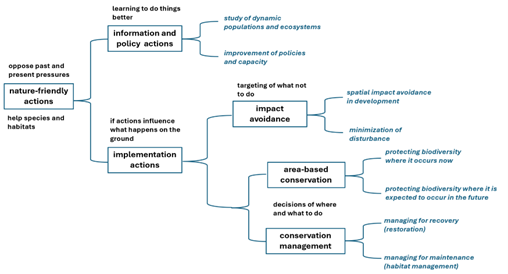
Another notion that clearly resonates with companies is cost-effectiveness, which is a standard requirement in business, but maybe less so in biodiversity science. Thinking of the typology of figure (1), it should be obvious that individual nature-friendly actions may have very different ecological mechanisms and effectiveness. In fact, what can be called information and policy actions have no immediate on-the-ground effects. Actions also vary massively in unit-costs and associated uncertainty. In a world of limited budgets it is important to make most of your investment, also in the context of biodiversity. Understand what you are aiming for, understand the options, make decision and move on to implementation.
Overall, one feels that mathematically and ecologically structured presentation generated interest and trust, maybe because such material helped in the understanding of the complexity of nature. Well-informed simplification is a related principle that Think Nature supports and I personally ascribe to, and which seemed to resonate with Japanese companies. Complexity necessarily needs to be simplified in biodiversity analysis, otherwise nothing will ever get done. It is not however sufficient to just simplify. The key is to first understand the whole, which then allows well-informed simplification that retains the core ecological and logical components of analysis so that analysis can be trusted.
Overall, it was my impression that there is increasing willingness to invest into nature-friendly activities, but the complexity of the world and maybe relative weakness of international guidance make it difficult to proceed with confidence. Many Japanese companies are large in the global scale, so their investments can indeed make a difference.
So these impressions were formed on the basis of many discussions and small observations. Communication was in a mix of English and Japanese, which I cannot follow (yet), and there may also be cultural aspects to communication that might have gone past my notice. Nevertheless, the above observations are in my best estimation largely true.
Aside from business there are many wonderful sides to Japan including beautiful nature, diverse and tasty food, and most importantly, people who are organized, kind, and considerate. – I’m much looking forward to my next business-visit to Japan.